Pick Up a Knife: The Case for Breaking Down Your Own Chicken at Home
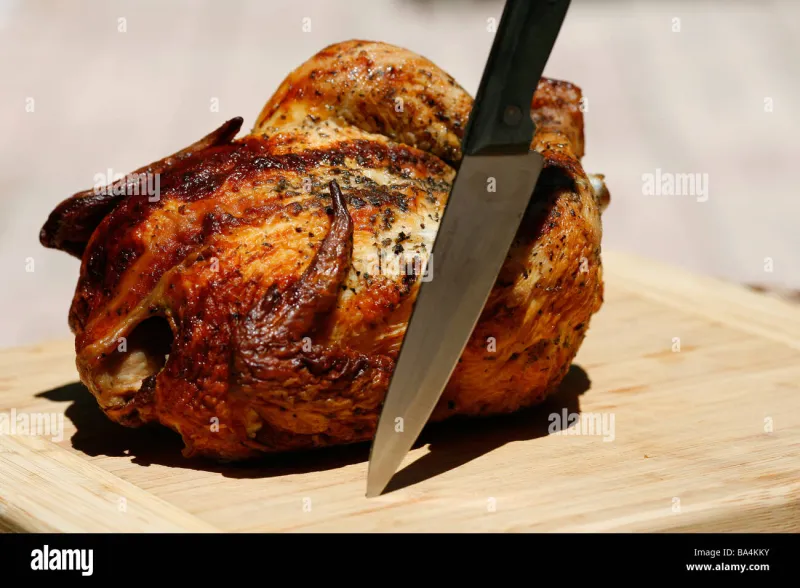
Photo: home cook jointing whole chicken on wooden chopping board with chef knife, via c8.alamy.com
There's a moment, usually somewhere around the third time you've paid supermarket prices for four chicken thighs in a polystyrene tray, when the penny drops. A whole bird — a proper, free-range, well-raised whole bird — costs less per kilogram, gives you more to work with, and frankly tastes better from end to end. The only thing standing between you and that realisation is a decent knife and about twenty minutes of your time.
Poultry butchery used to be an ordinary domestic skill. Not long ago, most households in Britain received a whole bird and simply got on with it. The rise of pre-portioned, vacuum-packed cuts changed all that, and somewhere along the way we collectively forgot that jointing a chicken is not a professional technique — it's a kitchen basic. The good news is it's coming back. Traditional butchers around the country are reporting renewed interest from home cooks who want to understand what they're buying, reduce packaging waste, and make their food budget go further.
Why Bother? The Honest Cost Comparison
Let's talk numbers, because this is where the argument gets compelling. A whole free-range chicken from a quality British farm typically costs somewhere in the region of £10–£14, depending on size and provenance. Break that down yourself and you'll yield two breasts, two thighs, two drumsticks, two wings, and a carcass that makes a genuinely excellent stock. Buy those cuts separately — particularly the breasts, which carry a significant premium — and you're looking at considerably more.
A bag of chicken wings alone can run to £4–£5 in most supermarkets. The carcass, which many people don't even consider buying pre-portioned, is the foundation of a stock that would otherwise cost you several pounds in a carton. When you add it all up, breaking down a whole bird yourself can save a meaningful amount over the course of a month, especially if poultry features regularly in your cooking.
Beyond the pounds and pence, there's the question of waste. Pre-packed cuts come with trays, absorbent pads, and layers of plastic film. A whole bird, particularly when bought directly from a farm or an independent butcher, often comes with far less packaging. That's a small but real difference if you're trying to be a bit more thoughtful about what your kitchen sends to landfill.
What You Actually Need
You don't need a professional butcher's kit. You need one sharp knife — a good chef's knife or a boning knife if you have one — and a sturdy chopping board. That's genuinely it. A pair of kitchen scissors is useful for snipping through joints and removing the backbone if you want to spatchcock, but they're not essential for a basic joint.
Keep your knife sharp. A blunt knife makes the job harder, less precise, and, counterintuitively, more dangerous. If you're not already in the habit of honing your blade before use, this is a good reason to start.
A Step-by-Step Guide to Jointing a Whole Chicken
The following method works for chicken, and with minor adjustments, for guinea fowl, poussin, and smaller ducks. Work on a clean board, keep a bowl nearby for trimmings, and don't rush.
Step 1 — Remove the legs. Place the bird breast-side up. Pull one leg away from the body until the skin stretches taut, then cut through the skin between the leg and the breast. Press the leg outward until the hip joint pops, then cut through the joint to separate the leg entirely. Repeat on the other side.
Step 2 — Separate the thigh from the drumstick. Feel for the joint connecting the thigh to the drumstick — there's a line of fat that usually marks it clearly. Cut straight through the joint. You'll know you've found the right spot when the knife passes through with little resistance.
Step 3 — Remove the wings. Pull each wing away from the breast and cut through the shoulder joint where it meets the carcass. Again, find the joint rather than trying to cut through bone.
Step 4 — Remove the breasts. Turn the bird breast-side up. Run your knife along one side of the breastbone, keeping the blade close to the bone as you work downward, letting the ribcage guide you. The breast will come away in one piece. Repeat on the other side.
Step 5 — Keep the carcass. Don't throw it away. Roast it in a hot oven for twenty minutes, then cover with cold water, add a halved onion, a carrot, a few peppercorns, and a bay leaf, and simmer for two hours. You'll have a stock that puts anything in a carton to shame.
What the Butchers Say
We spoke to a traditional high-street butcher in rural Yorkshire who has been breaking down birds for customers for nearly three decades. He's noticed a shift in the past few years. "People are coming in and asking to watch," he told us. "They want to understand the animal, not just buy a portion of it. That's a healthy thing."
He reckons the renewed interest is partly economic and partly philosophical. "When prices go up, people start paying attention to value. And once they start paying attention, they realise there's a whole skill set that got lost somewhere. It doesn't take long to pick up — an afternoon, really — and once you've done it a few times, it becomes second nature."
His advice for beginners: start with a larger bird. A big chicken or a small turkey gives you more room to work and makes the joints easier to find. "Don't be precious about it," he said. "The first one won't be perfect. The fifth one will be fine."
Making the Most of Every Part
Once you've jointed your bird, the cooking possibilities open up considerably. Thighs and drumsticks take well to long, slow braises — they're forgiving cuts that reward patience with tenderness. Breasts are best treated gently, whether pan-fried over moderate heat or poached in a flavoured liquor. Wings are brilliant roasted hard and fast with a simple seasoning.
The offcuts — the scrappy bits of meat clinging to the carcass after you've removed the main pieces — can be picked off after roasting the bones and stirred through a risotto or folded into a pie filling. Nothing is wasted. That's rather the point.
At Pleystowe Poultry, we've always believed that the best way to respect good meat is to use all of it. Learning to break down a whole bird is the most direct way to do exactly that — and once you've done it a few times, you'll wonder why you ever bought pre-packed cuts at all.